Nintendo hooked me as a kid. Can the Switch win over my son?

Standard

By Ian Sherr

I vividly remember the first Nintendo game I played.

It wasn’t long after the 1985 debut of the Nintendo Entertainment System in the US. I was around five years old and at my babysitter’s house in Fremont, California. It was a sunny summer day, and we were calming down after playing outside.

My sitter, who also took me for my first ride in a classic Volkswagen Beetle, sat my younger brother and me down in front of the living room TV. She’d just gotten a Nintendo and wanted to show it off.

She pulled out the controller, flipped the TV to channel 3, then took a game out of its holding case. I watched as she blew along its bottom to make sure there wasn’t any dust.

Then she popped it in and turned it on. Music started playing and the title appeared: Rad Racer.

The game was crude by today’s standards, but my younger brother and I were mesmerized. We watched as the car on the screen sped up, moved around, steered past other cars on the road and eventually crashed.

Then it was my turn.

Crash!

I laughed hysterically.

Then I did it again — and again. I sped up as fast as I could, then veered the car off the course.

Crash!

I was totally hooked.

Few companies get kids as well as Nintendo does. And fewer still have such a deep catalog of the kind of engaging and fun games that have kept me playing over and over again for the past three decades.

There’s the silly boxing game Mike Tyson’s Punch-Out!! (or Punch-Out!! as it was later called) on the Nintendo I started with. Or the cartoonish but beloved spaceship dogfighting epic Star Fox 64 on 1996’s Nintendo 64. There’s nearly every version of the racing game Mario Kart, too.

Now that I have an infant son, I’ve started drawing up a list of the nerdy stuff I plan to introduce him to. Nintendo games are high up there, alongside stuff like the Star Trek (except the odd-numbered movies) and Star Wars (sans the prequels — “what prequels?” I’ll joke.)

But now that Nintendo’s next-generation console, the Nintendo Switch, is coming to store shelves on Friday, I’m looking at the likely device my son might use when he’s ready to start playing his own games in a few years.

So, should I get him one?

There’s a dating site called TrumpSingles. It’s not fake.

Standard

By Ian Sherr

David Goss was at a Southern California bar on election night 2016, scribbling down ideas to rename TrumpSingles.com, his nascent dating site.

Since Donald Trump was about to lose the presidential election, Goss decided his site needed a new figurehead. Or at least a new name.

He considered Wealthy Person Dating, but that didn’t really roll off the tongue.

By day’s end, though, he received a news alert announcing that Trump had unexpectedly won the election. After that, people started flooding TrumpSingles.com.

Turns out it was the right name after all.

The week before Inauguration Day in January, Goss counted 18,000 active people on his site, more than twice how many were using it on election night. When Trump stood on the Capitol steps in Washington, DC and took the oath of office, TrumpSingles shot to 26,000 people.

Now, the site is pulling in enough cash — either by charging monthly fees for full use of the site or for individual messages — to cover his costs and for him to reinvest in the business. He even has a business partner.

“We didn’t expect to make it through November,” said Goss, 35, who used to help coordinate production for reality TV shows like “The Bachelor,” “Big Brother” and “Life Below Zero.”

Until now, the most harrowing challenge Goss faced was riding a snowmobile across a frozen ocean during a blizzard in Alaska. Now, he’s building a site named after one of the most unpopular presidents in US history. And it’s working.

Goss, who’s married and lives in the Santa Clarita Valley of California, isn’t the only entrepreneur to stumble into the world of online dating. Over the past few decades, sites devoted to matching people interested in all manner of topics have popped up. If you’re a sea captain looking for a first mate, as it were, there’s a site for you. Same with people who admire vampires, and video game players looking for a plus-one.

In some ways, they’re all offering an alternative to services like Tinder, Match.com, OKCupid and eHarmony, which sell themselves by promising large pools of people to choose from or by offering a sophisticated matching algorithm that trawls through listings before finding potential partners. But niche dating sites focused on religious affiliations — like JDate and ChristianMingle — are popular too. So, is it any surprise there’s one for Trump fans?

That doesn’t mean using sites like this is a good idea, said Nicole Ellison, a professor at the University of Michigan School of Information. “One of the potential pitfalls of online dating sites are that they encourage us to be more selective in not necessarily productive ways,” she said.

Often people end up choosing or dismissing people who have characteristics that don’t really matter in the end. “Technology can be enabling,” Ellison says, “but it can also encourage bad behavior.”

Here’s why tech has taken over our relationships

Standard

By Ian Sherr

If you had to explain dating in 2017 to a time traveler from the 1950s, what would you say?

“I would explain texting first, and how it takes five minutes now for people to decide they want to hook up,” says comedian Nikki Glaser. “I would tell women, ‘Buckle up, bitch, this is not going to be a fun ride.'”

Glaser, 32, has made a professional study of dating sites like Tinder and the hookup culture that experts say has reshaped many people’s sex lives. It provides lots of fodder for her comedy routine.

For past generations, relationship milestones meant things like “going steady.” Today’s relationships can strike up after a few minutes of text chats.

And since nearly everything is done using an app on a phone, “you can have a relationship with someone and never hear their voice,” Glaser says.

So this is dating in the modern age. Having fun yet?

Dating apps are so commonplace now that swipe right, the way you show you like someone on Tinder, has become part of our everyday language. “Swipe right” now means “anytime you make a good choice or approve of something,” according to Urban Dictionary.

The internet has been “transformational” to the way we have relationships, says Pepper Schwartz, a professor of sociology at the University of Washington who studies dating. She’s noticed, for example, the speed at which technological trends ripple through our culture, and how quickly people become adopters.

“It changes us,” she said. “It’s a very powerful presence in modern life.” That’s particularly true in courtship and dating, Schwartz said.

Go back a couple hundred years, and the world was transitioning from arranged marriages to “love.” (Schwartz said researchers could tell because children weren’t getting married in order of oldest to youngest anymore.) Up until the automobile, airplane and mass education, people usually married someone nearby, such as a neighbor, a fellow churchgoer or the girl next door.

itscomplicatedbugphotov2heart.png

Click for more coverage

But these shifts fractured many communities. That, along with sex education, family planning and, in some places, egg freezing as a company-provided health benefit, has meant many people are waiting longer before they settle down.

Who hasn’t read about how millennials are less religious, have fewer kids and, despite the popularity of Tinder and the less formal dating culture it’s helped introduce, may even be having less sex? The term “cybersex,” which used to mean people describing sexual experiences to each other over chat, has morphed into “sexting” — and it’s a far more accepted part of life. Varying sexuality and gender identity are more accepted today as well.

So as time passes and people move around, the traditional pools from which you’d normally find a partner pretty much disappear, Schwartz said. That leaves today’s relationship seeker with few options other than to look online.

It’s no wonder then that over 90 percent of America’s more than 54 million singles have tried online dating, according to the Statistic Brain Research Institute.

Over the past decade, dating services have been set up for pretty much any interest. If you wanted to date only people who like Star Trek, normally you’d have to weed through several p’tahks before finding someone to join your crew, as it were. Now there’s a site for pretty Star Trek fans, as well as sites for vampire enthusiasts, gamers and even devotees to the writings of Ayn Rand.

There’s even a site for supporters of the newly inaugurated president of the United States. It’s called TrumpSingles.com.

Death to Apple’s Mac Mini: I made a Hackintosh

Standard

By Ian Sherr

If you ask me what type of tech I have at home, you’d think I live in an Apple Store.

We have iPhones, iPods, iPads, Apple TVs and Mac laptops. There isn’t a PC in sight.

I’m well-known for pushing my family to switch to Apple, too. No, it’s not a cult thing. I’m just lazy.

Did you know how much easier it is to fix these things? IBM says  PCs cost about three times more than Macs to keep in good running order. And it’s true. Just ask my in-laws how much less time I spend fixing computers when I visit, now that they’ve junked their old Windows-based PCs.

My older brother, who convinced me to buy my first Apple computer (a PowerBook in 2003), often tells people he picks Macs because he doesn’t have to routinely fight with them to work.

But that changed for me in October.  Tim Cook, Apple’s CEO, got on stage at the company’s Cupertino, California, headquarters to announce new Mac computers. Namely, the new MacBook Pro laptop, redesigned with, among other things, a nifty touchscreen built into the keyboard.

I had my wallet out and waiting, but it wasn’t for that. I needed a new desktop.

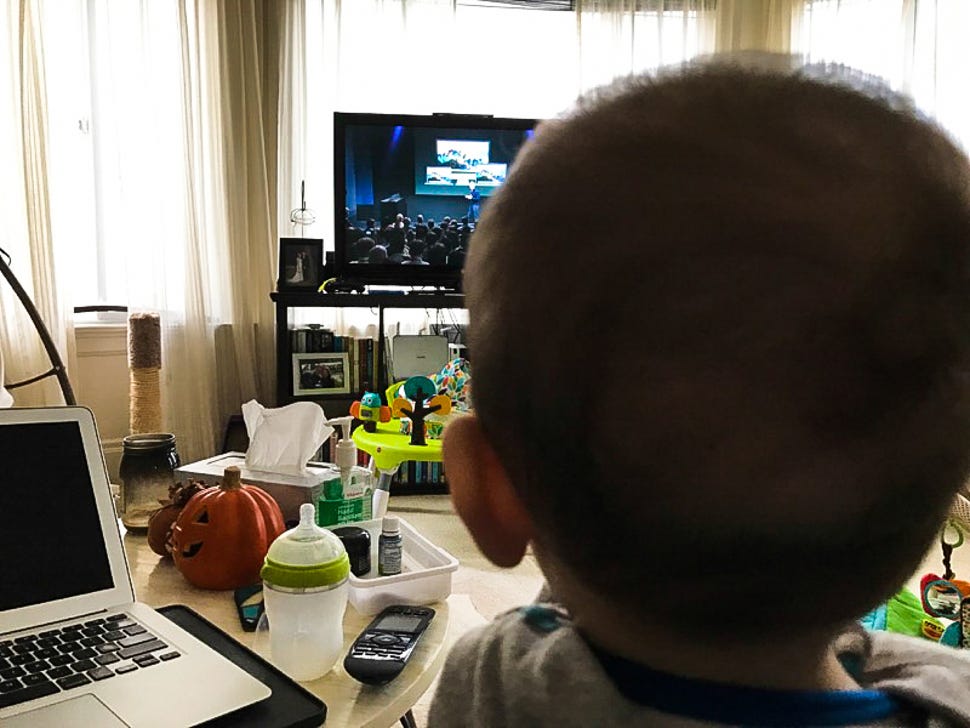
I sat and watched the event along with my infant son, hoping Apple’s  Mac Mini computer would be updated with faster chips. I wanted a new Mac Mini because it’s about the size of two best-seller books stacked next to each other — easy to stash right beside our TV. It also starts at only $499 (you have to supply the monitor, keyboard and mouse, which I already have).

The problem is Apple hasn’t updated the Mac Mini since October 2014.

For the past several years, I’ve used a nearly 7-year-old MacBook Pro as a media center, storing all our family photos, videos, iTunes movies, music and everything else. I’ve also started using Plex, an app that allows me to stream and search for all that stuff the same way you use Netflix, but also for — y’know — pictures of my son’s first smile.

This year, it was time for a replacement. Sadly, MacBook Pro laptops were all that’d be on tap. Even Apple’s iMac (last updated October 2015) and Mac Pro (last updated December 2013) desktop computers were neglected. If I bought a Mac Mini today, I’d be paying full price for a machine more than two years old.

Apple, you let me down.

My son's first Apple event ended in disappointment.

My son’s first Apple event ended in disappointment.

Can tech help Alzheimer’s sufferers?

Standard

By Ian Sherr

My mother was a brilliant woman. She earned three bachelor’s degrees and a master’s, and could have become a doctor if not for the rampant sexism she faced in college in the early ’60s.

Instead, she worked for a major airline, where she applied her math smarts calculating a cargo load’s weight and balance that would allow a plane to safely take off.

But after spending nearly a decade working the overnight shift, she was starting to get absent-minded. At first it was little things, like she’d go somewhere without the documents she needed. Then it was big things. Then she got in a car accident.

My mother was shocked when she came out of the doctor’s office after weeks of testing. She was diagnosed with early-onset Alzheimer’s disease. At 57 years old.

My mother was told to do anything that required thinking. She did crosswords. She read books. And since she was already good at math, she calculated the value of her invested retirement nest egg against the stock market’s moves.

If she were alive today, she probably would type Alzheimer’s into an app store. The first hit is an Alzheimer’s patient-care app called MindMate, which includes interactive brain games it claims will “stimulate user’s cognitive abilities based on world-leading research.” There are dozens more.

Over the past few years, there’s been an explosion of apps and websites promising to solve what medical science hasn’t. Many claim they’ll improve the brain, or even help fend off the disease. Experts say nearly all are peddling false hope to people who have just been told they’re going to lose their minds. There’s no scientific proof any of these apps do what they claim. But since more than 5 million Americans are living with Alzheimer’s there’s big demand for a fix.

“People are willing to try anything when they’re desperate,” says Creighton Phelps, a deputy director at the National Institute on Aging.

Star Trek 50th anniversary: ‘Deep Space Nine’ star Nana Visitor had one wish as Nerys

Standard

As part of CNET’s coverage of Star Trek’s 50th anniversary, I chatted with a dozen cast members from across the franchise about everything from Star Trek’s inclusive message to whether the ships are actually real.

By Ian Sherr

If Nana Visitor could have done one thing on Star Trek, she would have been captain.

Call it galactic jealousy that Kate Mulgrew ended up as Capt. Kathryn Janeway of “Star Trek: Voyager,” running a ship with a lot of strong female characters.

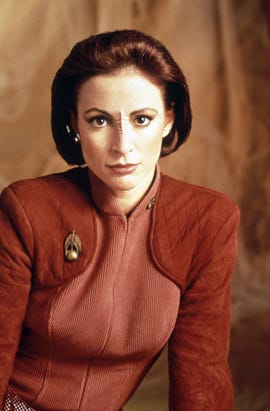
Visitor was powerful on her own. As Kira Nerys, Visitor played a freedom fighter who fought back the invasion of a militaristic species. Her race seemed to embody allegories to World War II, specifically the French Resistance and the Holocaust. Nerys was a fighter. Visitor loved that about her.

Even then, she wanted more.

“I really wanted to do Captain Janeway,” she said. “I wanted everything, but I didn’t want to leave Kira…I wanted to do it all.”

Visitor (whose first name is pronounced na-NAW) clearly had an emotional connection to her Star Trekexperience that made it more than a job. Maybe that’s because Star Trek was the only TV show she watched as a teenager, usually while eating dinner before work.

Or maybe it’s because executive producer Rick Berman wooed her to join the cast by telling her about the gritty and emotional stories “Deep Space Nine” would explore during its 1993-1999 run. That was enough to get her to ignore her manager, who told her being on Star Trek was career suicide.

startrek50cropped2.jpgFor the next seven years, she lived and breathed Star Trek nearly 16 hours a day. “It’s taken up a big part of my life and an important one,” she said.
Visitor also identified as Nerys so much she sometimes still slips into talking about her in the first person. “When we’d go on the Defiant,” she said at one point, referring to a ship on the show. Then she caught herself and said, “OK, when we’d go on the set of the Defiant…”

The realness of what the Star Trek series was able to create with sets, props and makeup had a profound effect. “I don’t have a really good handle on reality, not when my senses are being filled like they were on the show,” she said. “It was happening, and it was important. It was real to me.”Click for full coverage.

Visitor is currently working on a production of a play she wrote called “Bardo,” which explores suicide.

Star Trek 50th anniversary: How Gates McFadden kept her son from confusing her with Dr. Crusher

Standard

As part of CNET’s coverage of Star Trek’s 50th anniversary, I chatted with a dozen cast members from across the franchise about everything from Star Trek’s inclusive message to how to play a fake doctor in the future.

By Ian Sherr

Gates McFadden didn’t watch much TV before she landed a role on the Star Trek revival “The Next Generation.” And when she admitted to friends she had almost no Trekkie knowledge, they were horrified.

“I didn’t understand what warp speed is or what a Klingon is,” she said.

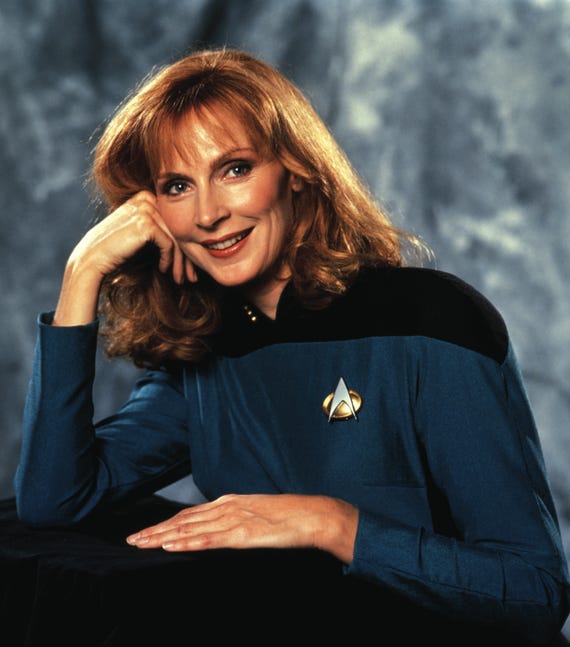
That’s probably why she turned down the role. Twice. It took several conversations with Star Trek creator Gene Roddenberry to turn her around. His goal for her character, Dr. Beverly Crusher, was to give a woman a command position on the Enterprise and much more substance than Communications Officer Nyota Uhura had in the original series.

“It’s a character that has authority and it’s something people didn’t have in the show,” she remembered Roddenberry telling her. Crusher would be able to challenge Capt. Jean-Luc Picard, played by Patrick Stewart. She’d also be his love interest, in addition to being a widow and single mother.

“I had grown up when Gloria Steinem had happened and the question was, Can women have it all?” she said. “This was a different role. There was something modern about it.”

Even so, she felt the show didn’t dig as deep on some aspects of her character, like single parenting.

She also faced the challenge of being on “The Next Generation” and raising her son, who was born about halfway through the show’s 1987-94 run. Though many of us would be jealous of parts of his childhood (“My son learned to walk on the bridge, literally”), she struggled with separating Gates McFadden from Beverly Crusher.

One way she handled that was by letting her son watch rehearsals, but not the finished show. “I didn’t want him to project onto my character,” she said. “I didn’t want him to confuse realities.”

There were times the situation worried her. Once, she was inspecting an action figure of her character for approval, and her son blurted out, “Oh, a mommy doll!”

It all turned out fine, she said, and she’s happy with the 25-year-old man he’s become.

As to her on-set son, Wesley Crusher, she felt  he got a bad rap from fans who complained he was both annoying and boring.

Star Trek 50th anniversary: Robert Beltran says the Prime Directive is ‘fascist crap’

Standard

As part of CNET’s coverage of Star Trek’s 50th anniversary, I talked with a dozen cast members from across the franchise about everything from Star Trek’s inclusive message to how they really felt about their characters.

By Ian Sherr

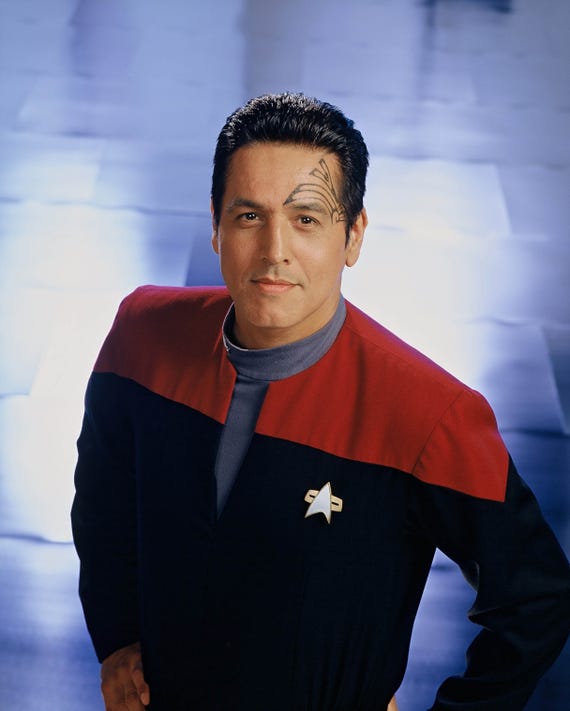
Robert Beltran is known for two things in the Star Trek universe: playing Commander Chakotay in “Star Trek: Voyager” from 1995-2001, and complaining about it to the press.

Get Beltran going, and he’ll grumble about just about anything related to Star Trek. He didn’t like the monotony of shooting. (“I often say it’s like working in a factory.”) And he’s not a fan of its predictable format. (“I kept telling the writers, ‘If you can just take three minutes off a bridge scene and write another scene with human beings talking, the show is going to be much better.'”)

He even rails against the show’s “Prime Directive,” a guiding principle that prohibits Starfleet characters from interfering with the development of alien civilizations.

“The idea of leaving any species to die in its own filth when you have the ability to help them, just because you wanna let them get through their normal evolutionary processes is bunk — it’s a bunch of fascist crap,” he said. “I much prefer the Cub Scout motto.” (The Cub Scout motto, by the way, is about doing your best and helping others.)

So, it’s safe to say Beltran’s not much of a Trekkie. He barely watches TV anyway. He prefers the arts, music and stage work. He writes poetry and composes music.

startrek50cropped2.jpgThough initially he hoped the Chakotay character could present opportunities to explore culture and identity, Beltran, a child of Mexican immigrants, ultimately realized that wouldn’t happen much. But he’s made peace with it, and come to appreciate aspects of his life as a pseudo nerd-celebrity. Like many  Star Trek cast members, he appreciates the fan enthusiasm that’s helped keep the franchise alive.

“I also knew I was going to work with a bunch of great actors and a great crew,” he said, adding that the seven years he spent on the series were well worth it. “I wouldn’t trade them for anything.”

Beltran, 62, is currently turning toward more theater work and focusing on his music

Star Trek 50th anniversary: Can you imagine an alien that squawks? John Billingsley did

Standard

As part of CNET’s coverage of Star Trek’s 50th anniversary, I chatted with a dozen cast members from across the franchise about everything from Star Trek’s inclusive message to how to convincingly play an alien.

By Ian Sherr

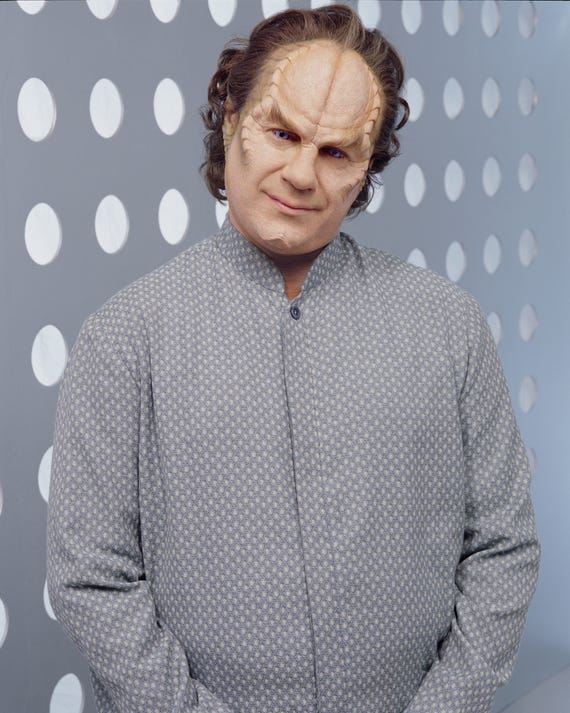
If John Billingsley had his way, you’d have heard him squawk like a bird in the middle of his lines.

He was auditioning for the part of Phlox, the ship’s doctor on “Star Trek: Enterprise,” which ran from 2001 to 2005. The character was part of a race of aliens called the Denobulans that hadn’t been depicted on the Star Trek shows before.

When the actor read for the part, the producers requested a slight alien accent. Billingsley had no idea what that meant or what a Denobulan would sound like. So after unsuccessfully bouncing a few ideas off his wife, he decided to give his character “kind of an Indian lilt.” And a squawk.

Since no one told him not to squawk, he continued to do it “in moments of rapture,” even after he landed the part.

But the bird sounds were not to be. When he tried squawking during production for the pilot, they told him to stop screwing around.

“I figured, go for the job you would like to have,” Billingsley remembers with a laugh. “At the time I was auditioning, I thought I’d like to be a bird — and I was going to give him something to flap his wings about.”

Though Billingsley played an alien, he appreciated the fact that he didn’t have to learn the long and intricate history of the Vulcans or how to speak Klingon. “What were the Denobulans like? They were like me.”

Billingsley spent two and a half hours in makeup each day becoming his character. That’s about the same amount of time it took  Michael Dorn, who played Worf on two other Star Trek shows, to morph into an Klingon. Billingsley routinely turned on classical music and squinted at The New York Times without his glasses while being transformed.

Like many Star Trek cast members, Billingsley, now 56, began his career as a stage actor. He moved to Los Angeles to try his hand at TV at the age of 35 and ended up as a “character actor.” In Hollywood parlance, that means he played a specific type. He wasn’t the crusading attorney or the gruff cop. Instead, producers cast him as a child predator. A lot.

startrek50cropped2.jpgHe was up for the part of the tech whiz on the action show “Alias” once, but didn’t get it.

So when the opportunity to join “Star Trek: Enterprise” came along, Billingsley was open to it. He’d watched the original “Star Trek” as a child, but he didn’t, in his words, “grok” it. He preferred magazines and books, including the works of notable sci-fi authors Arthur C. Clarke and Isaac Asimov. “I have been a big reader all my life,” he said.

That’s probably why he felt a connection to Phlox, whose Buddhist-like attitude he appreciated. He also liked that his character used holistic medicine and didn’t rely on technology, at least not too much. “It was nice to play a good guy and someone whose value system and temperament is much closer to my own,” he said.

Billingsley, you see, is a self-described  Luddite, and found the technobabble Star Trek is so well known for the most challenging part of the job. Thankfully, most of it was medical babble, which was easier to manage.

Star Trek 50th anniversary: Don’t call Tim Russ a Trekkie

Standard

As part of CNET’s coverage of Star Trek’s 50th anniversary, we talked with a dozen cast members from across the franchise about everything from Star Trek’s inclusive message to how actors show emotion when their character has none.

By Ian Sherr

Tim Russ may be among the most-cast actors in Star Trek shows and movies, but don’t call him a Trekkie.

In fact, the 60-year-old actor, who appeared on “Star Trek: Voyager” from 1995 to 2001, for many years saw Star Trek as just another job. Sure, he’d seen reruns of the original series, mostly since there weren’t many TV channels when he was growing up. But before he began his Star Trek career, he knew about as much about the franchise as he did about “Gilligan’s Island.”

“It was my job,” he said. “It could have just as well been ‘Baywatch.'”

Russ is a sci-fi nut, though, and when he was cast, he took the part because he remembered how interesting and edgy the original Star Trek show’s stories were.

“They had social commentary,” he said. And to a black kid growing up in the turmoil of the ’60s, the issues the show tackled hit close to home. Gene Roddenberry, the creator, “dealt with the conditions of what was happening,” Russ said. “I was very much aware obviously of what was going on with the turmoil of civil rights and Vietnam, and that was all brought out in his stories.”

startrek50cropped2.jpg

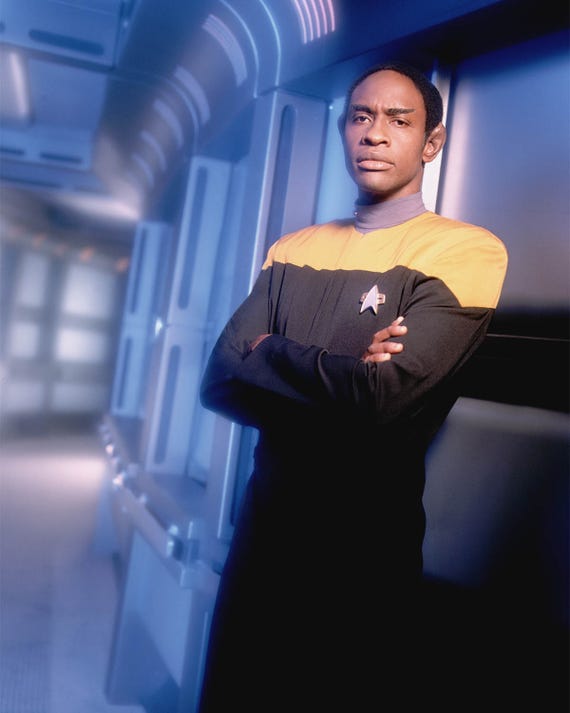
Russ was first cast on “Star Trek: The Next Generation” as a terrorist named Devor, not the character he’d ultimately play. Russ held two other roles — one as an unnamed “Lieutenant,” the other as a Klingon mercenary called T’Kar on “Star Trek: Deep Space Nine” — before being cast as Tuvok, the Vulcan head of security for “Star Trek: Voyager.” He called it a seven-year audition process.

Russ likes to think about big-picture issues, which is probably why he appreciates sci-fi so much. “It allows you to challenge the human condition,” he said. He particularly enjoys self-contained stories, like H.G. Wells’ novel “The War of the Worlds” and the TV show “The X-Files.”

The actor is still involved in Star Trek, though not in an official sense. He’s directed and acted in fan projects like “Star Trek: Renegades.” Some of his most recent work outside the Star Trekuniverse includes “Junkie,” a gritty film he directed about a small town riddled with a heroin epidemic.