Star Trek 50th anniversary: The show turned Robert Picardo into a giant science nerd

Standard

As part of CNET’s coverage of Star Trek’s 50th anniversary, we talked with a dozen cast members from across the franchise about everything from Star Trek’s inclusive message to whether Siri can replace the ship’s computer.

By Ian Sherr

Robert Picardo thought he’d just landed the most boring role in the Star Trek universe.

He’d been asked to play the “Emergency Medical Hologram,” an interactive computer doctor on “Star Trek: Voyager,” a show about the seven-year journey home for a starship flung across the galaxy by an alien being. Picardo’s character, called “The Doctor,” had nine lines in the pilot episode that ran in 1995, and none of them seemed interesting to him.

“I thought he was humorless,” Picardo said. Instead, he wanted to play Neelix, a new alien who enthusiastically joins the Voyager crew as a guide and cook. The actor was, however, a bit worried about the makeup. Producers wouldn’t tell him if it involved a prosthetic head, something pretty much every actor despises because the makeup process is long and the get-ups are usually uncomfortable to wear.
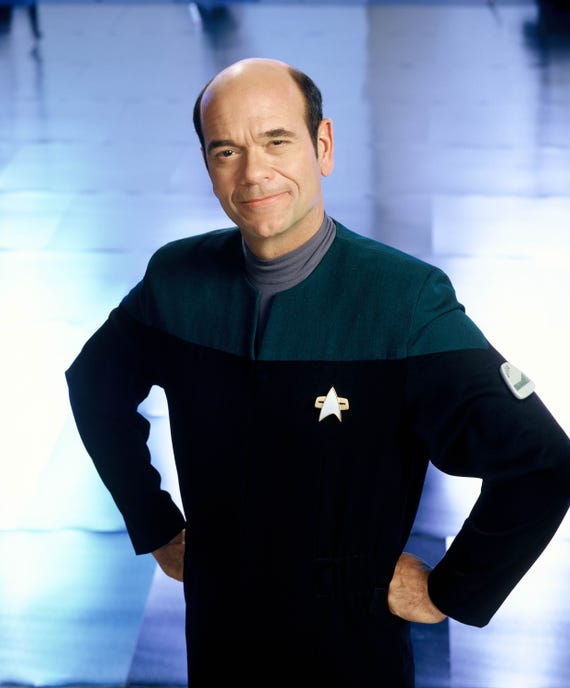
voydoctor2000-2001409.jpg

Robert Picardo as The Doctor (who names himself “Joe” in the last episode. Yes, we waited seven years for “Joe.”) / CBS

He didn’t get the part, but the producers contacted him again to play The Doctor. They told him to be funny, but he still thought the dialogue seemed too serious. “I bluffed my way through the audition,” he said.

When he got to the part where The Doctor is left alone in the ship’s sick bay, he looked around and said the line, “I believe someone has failed to terminate my program.”

Then he ad-libbed: “I’m a doctor, not a nightlight.”

That channeling of Dr. Leonard McCoy’s famous catchphrase from the original Star Trek series (“I”m a doctor, not an escalator!“) landed him the part and helped him change The Doctor into one of the most beloved characters on “Voyager.”

Pretty soon, Picardo realized the ongoing gag about The Doctor was that he had an awful bedside manner — and a superiority complex. He was programmed to embody nearly all the show’s medical knowledge, but he was stuck treating the crew’s scrapes and bruises.

At one point, Picardo recommended to the writers that his character become an opera fan. The idea of seeing his emotionless face on the screen while gut-wrenching arias about love and loss play behind him seemed hilarious.

Turned out he was right.

Picardo, now 62, graduated from Yale University with a drama degree after starting as a pre-med major.

He seems to have a penchant for playing neurotics and doctors. You may remember him from “The Wonder Years” as Coach Cutlip, a PE teacher whom Picardo imagined as wanting to teach English but who gets shafted with something else. “I played a character who had the IQ of a stupid walrus,” he said. The role  earned him an Emmy nod.

In “China Beach,” he played a doctor drafted into the Vietnam War who starts the show being kicked in the groin by a woman disgusted by his sexist attitude.

After “Star Trek: Voyager,” which ran from 1995 to 2001, Picardo got involved in another popular sci-fi project. This time, it was the “Stargate” franchise of TV shows about a modern secret military program using ancient alien technology to travel to the stars. He was supposed to play a bureaucrat whose inquiry justified  a clip show. But his “douchebag” version of The Doctor’s bedside manner went over so well the producers invited him to join the cast.

startrek50cropped2.jpg

The Doctor changed Picardo’s life in other ways. He was asked to join The Planetary Society, co-founded by famous astrophysicist Carl Sagan. The nonprofit acts as an advocacy group for space science and exploration, and it has led Picardo to work with celebrated figures like Bill Nye and Neil deGrasse Tyson.

At first, Picardo said it seemed a little weird being revered while sitting on stage next to actual astronauts. “Now I not only made peace with it, I went ‘Gosh, if I’m gonna get this opportunity, then I’m gonna celebrate it and embrace it and see what I can do in my own small way, to help bring the science fiction fan to real science,'” he said.

Asked what type of Star Trek tech he wished he had, Picardo didn’t say “the transporter” like nearly everyone else interviewed for this series. Instead, he talked at length about  the $10 million Qualcomm XPrize to invent a noninvasive medical scanner — the real-life equivalent of the medical tricorder from Star Trek that could instantly detect any illness or injury.
Star Trek 50th anniversary: Poking fun at Trekkies made this Questarian value them more

Standard

As part of CNET’s coverage of Star Trek’s 50th anniversary, I talked with a dozen cast members from across the franchise about everything from Star Trek’s inclusive message to how best to lampoon the Trek universe.

By Ian Sherr

What if TV broadcasts of Star Trek were intercepted by a technologically advanced but naive race of aliens?

That’s the premise behind “Galaxy Quest,” a 1999 parody/homage that lovingly hits on every aspect of Star Trek, from the corniness of the original series to the incomprehensible technobabble to the pajamalike costumes and, of course, the franchise’s dedicated fans. You didn’t need to know Star Trek to get the gags, but diehards could spot many inside jokes, including Alan Rickman’s masterful sendup of Leonard Nimoy’s love-hate relationship with his character, Spock.

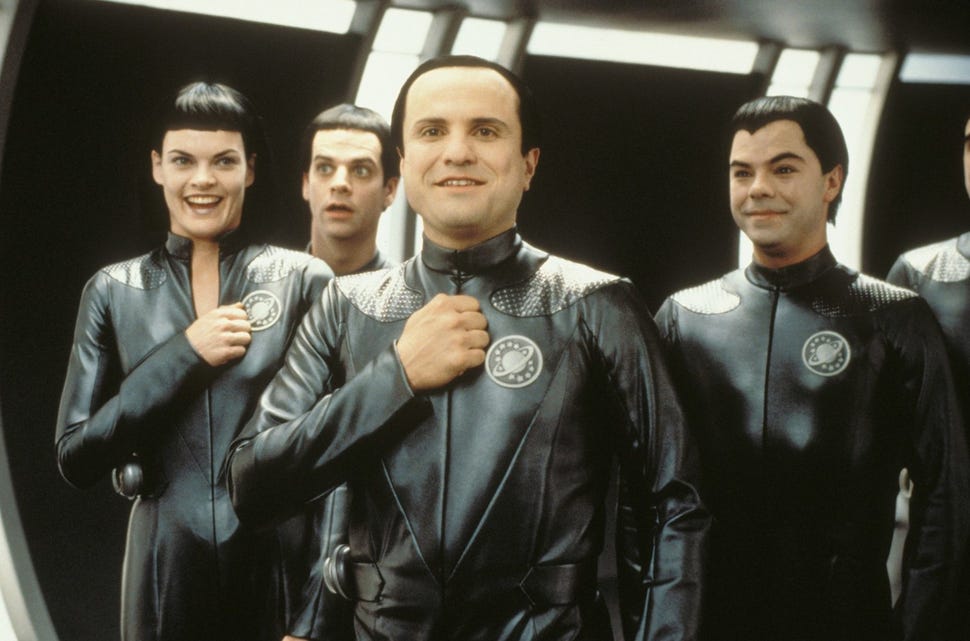
But it was Enrico Colantoni who won over many a Trekkie’s heart with his portrayal of Mathesar, leader of the Thermians, the alien race at the heart of “Galaxy Quest.” The civilization of octopoidal aliens was in disarray until broadcasts of the “Galaxy Quest” reached their planet from Earth.

Believing the TV episodes to be “historical documents,” the Thermians modeled their lives on the show’s teachings. And when they got into trouble with the evil General Sarris, they head for Earth and ask for help from the “Galaxy Quest” actors, believing them to be extraordinary space-farers.

Although Colantoni knew about Star Trek — fellow Canadian William Shatner is a legend, after all — he didn’t know about the conventions “Galaxy Quest” would parody. “It didn’t dawn on me there was a whole subculture.”

startrek50cropped2.jpgTo help create Mathesar, he drew from “The Coneheads,” a massively popular “Saturday Night Live” sketch about aliens with conical-shaped heads stranded on Earth. He borrowed the characters’ monotone speech, but replaced their robotic personalities with a heartfelt innocence.

“I made him born again,” Colantoni, now 53, said of his character. “His innocence was so transparent. He wasn’t hiding anything.”

“Galaxy Quest” fans may remember talk of a “Galaxy Quest” TV series in the works before actor Rickman died. The death stopped any efforts, Colantoni said, and he hopes it stays that way. But if a TV series does come to be, he wants to be invited, because he enjoyed playing an alien.

“Any character where you’re allowed to extend the imagination beyond the here and now is great fun,” he said. “I know how much fun an actor has when they put on goofy makeup.”

Of the many things he learned from playing Mathesar, Colantoni said he developed a deep appreciation for Star Trek’s fans. “When I found out these people were real, I discovered compassion where I might have made fun of them before,” he said. “They’re no different than a sports fan or a fan of anything.”

It also taught him that sci-fi is about the human spirit. “Human evolution is where Star Trek lives,” he said.

Colantoni’s since gotten into directing, including an episode of the sci-fi drama “iZombie.”

Star Trek 50th anniversary: How the cosmos forced Dominic Keating to watch reruns

Standard

As part of CNET’s coverage of Star Trek’s 50th anniversary, I talked with nearly a dozen cast members from across the franchise about everything from Star Trek’s inclusive message to their favorite characters.

By Ian Sherr

Dominic Keating watched the original series religiously as a child growing up in the UK, but he didn’t keep up with Star Trek after that.

It wasn’t until he was living on a commune in Malibu, California, in 1994 that he began watching again. He was sharing a satellite dish connection with someone, and that someone controlled the box. It was either set on adult programming or “Star Trek: The Next Generation.”

That ended up being a good thing, because fellow British actor Patrick Stewart, became a role model. And so, when after seven years in Hollywood a part in Star Trek came along, “I knew I’d hit the mother lode,” he said.

Keating only watched a few episodes of “Star Trek: Voyager,” a couple of the older movies and “Star Trek: Deep Space Nine.” But he knew Star Trek was going to change his life.

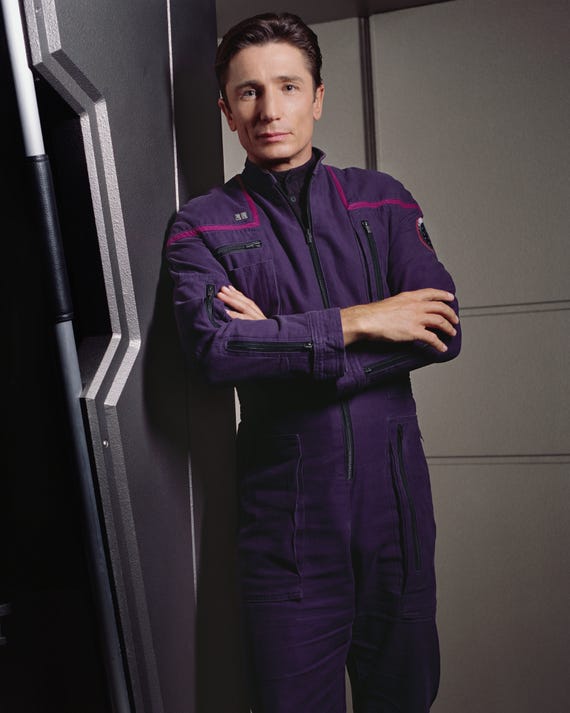
What he loved most about the experience, was working with people like Scott Bakula, best known for starring in the sci-fi series “Quantum Leap” a decade earlier. Bakula signed on as Captain Jonathan Archer on “Star Trek: Enterprise,” which ran from 2001-2005. Bakula was a real gentleman, Keating said. To this day, whenever he’s confronted with a challenging situation, he asks, “What would Scott do?”

Keating also really likes the conventions: “It’s like being Brad Pitt for the weekend.”

startrek50cropped2.jpgNow 55, Keating has kept his sci-fi connections alive by voice-acting in the hit dungeon exploring game Diablo III, and joining the cast of the upcoming sci-fi comedy film “Unbelievable!!!!!” He also recently recorded an audiobook version of “The Iliad.”

Here are edited excerpts of Keating’s answers to my warp-speed round of questions.

Star Trek 50th anniversary: Jeri Ryan reaaaaally wants a transporter

Standard

As part of CNET’s coverage of Star Trek’s 50th anniversary, I talked with a dozen cast members from across the franchise about everything from Star Trek’s inclusive message to how it feels to be a sex symbol to nerds.

By Ian Sherr

Jeri Ryan didn’t want the role at first.

The then up-and-comer was trying to kickstart her career after earning a theater degree and winning the Miss Illinois beauty pageant (she later competed in Miss America, coming in fourth place).

“I wasn’t remotely interested in science fiction,” Ryan said of her pre-Star Trek days. Sure, she’d watched some episodes of the original series. But she’d also heard the shows had a history of stymieing some actor’s careers.

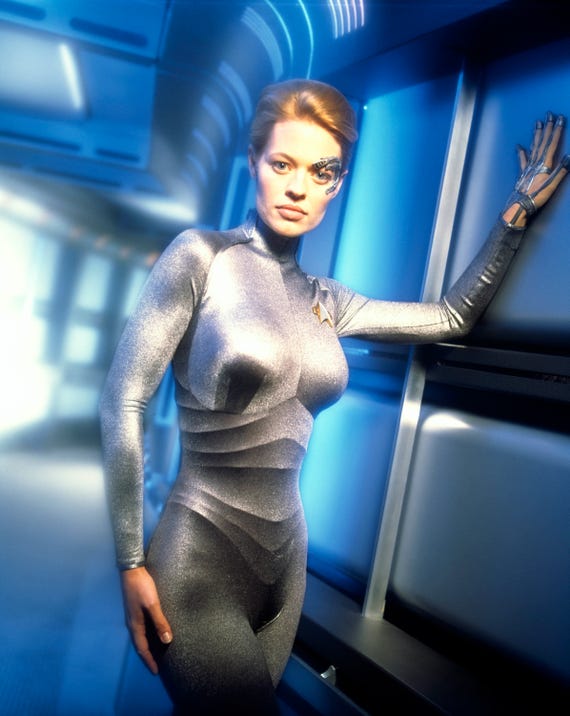
Then Ryan read about her character, Seven of Nine, a human kidnapped as a young girl by a cybernetic race known as the Borg. She then spends decades participating in the atrocious “assimilation” of other species before she’s snatched back by the Voyager crew. Aboard the ship, she begins to rediscover her humanity.

One audition scene involved her sharing with her eventual love interest memories of laughing during her pre-Borg childhood.

“It showed so much potential for the character,” said Ryan, now 48. “It was beautifully written.”

After she joined “Star Trek: Voyager” in the middle of its 1995-2001 run, ratings shot up more than 60 percent. It may have been her compelling storyline, but it might also have had something to do with her skin-tight uniform. She wasn’t bothered.

“The character herself was the complete opposite of a sexual character,” she said. “It was the antithesis of what this character was aware of.”

startrek50cropped2.jpg

Anyone who’s followed Ryan knows she wasn’t pigeonholed. Within a month of “Voyager” ending, she had a part as a lawyer-turned-teacher on “Boston Public,” a drama about inner-city schools. She’s since become a prolific TV actor, with roles in “Bosch,” “Body of Proof,” “Leverage,” “Major Crimes” and “Helix.” (Some of her co-stars are having quite a good run as well.)

“It gave me a career,” Ryan said of  Star Trek. And that’s why she attends Trek conventions, to thank fans for making it all possible.

Star Trek 50th anniversary: Worf wasn’t a wuss thanks to Michael Dorn

Standard

As part of CNET’s coverage of Star Trek’s 50th anniversary, I talked to a dozen cast members from across the franchise about everything from Star Trek’s inclusive message to whether they really could speak Klingon. 

By Ian Sherr

When Michael Dorn was getting ready for his role as Worf on “Star Trek: The Next Generation,” the showrunners barely told him anything about his character.

Well, that’s not entirely true. He did get one hint from Gene Roddenberry, the former airline pilot who dreamed up Star Trek. “Gene just said, ‘Make the character your own,'” Dorn said.

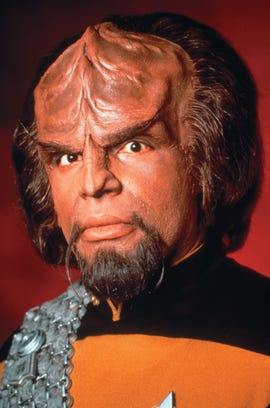
Worf was born to a warrior race of aliens called Klingons. They routinely went to war with the United Federation of Planets, the organization upon whose Enterprise starship the show took place. Now, Worf was going to be a member of the crew.

tng-worf00000993d.jpg

Dorn as Worf. It may look simple, but that forehead took hours to put on. / CBS

Dorn though it would make sense a Klingon would find it hard to be accepted.

So, while watching his colleagues act out scenes without him, Dorn noticed the camaraderie developing among the characters. He decided to do something different — make Worf an outcast.

Dorn took many subtle actions to make Worf feel out of place. For the character’s voice, he spoke in lower tones and in a more deliberate way. He also made Worf seem more anxious to go to battle than the rest of the crew, always the first to warn that an alien wasn’t trustworthy or that they should be ready to fire on a likely adversary.

startrek50cropped2.jpg

The result was that Worf was a commanding presence. But Dorn was worried it wouldn’t last. The security officer he played was routinely beat up by aliens invading the ship. Soon, he believed, the audience wouldn’t trust that Worf was a capable warrior.

Roddenberry reassured him the scenes weren’t meant to make Worf look weak, but rather to make the invading aliens look strong. Still, Dorn protested. So they found a compromise. Worf would use sword-like weapons in battle, making him seem more capable and harder to defeat.

After some research, Dorn and the show’s visual-effects producer, Dan Curry, invented the bat’leth, a double-sided scimitar-like weapon. They also created a form of Klingon martial arts with which to use this new weapon in battle.

The bat’leth has since become one of the most iconic pieces of Star Trek lore.

Star Trek at 50: Cast members spill insider tales of epic ad-libs, favorite captains

Standard

By Ian Sherr

Got a Star Trek story?

Maybe, like me, you dressed in starship captain uniforms for Halloween and snuck into the family room past your bedtime to watch reruns, no matter how tired you’d be the next day at school.

Or maybe you never watched “Star Trek,” but you still know the difference between Klingons and Romulans. At the very least, you probably know how to separate your fingers into the iconic Vulcan salute and offer up a “Live long and prosper.”

With the Star Trek franchise turning 50 on September 8, I asked a dozen cast members from six of Star Trek’s TV shows and movies, including Zoe Saldana, Gates McFadden and Jeri Ryan, to share their stories for CNET’s Star Trek at 50 anniversary series.

startrek50cropped2.jpgWhen Star Trek was born in 1966, it was the heart of the Cold War and the scars of World War II, which ended just two decades before, were still fresh. That’s why many viewers were surprised to see a Japanese helmsman working alongside a Russian ensign on the show.

They were joined by a black woman who served as the communications officer, a Scottish engineer working tirelessly to keep the ship running and an emotionless alien science officer with pointy ears. The divisions that defined the world at that time didn’t seem to matter to Star Trek creator Gene Roddenberry.

Michael Dorn, who starred in two Star Trek shows and five movies and is best known for playing the Klingon Worf, remembers how the original TV show stood out from the westerns and spy thrillers typical of ’60s TV.

“When this came about it was like, ‘Oh my God,'” Dorn said. “It was groundbreaking and different.”

Star Trek went on to become a cultural touchstone that spawned six other TV shows, including a new series called “Star Trek: Discovery,”  coming from CNET parent company CBS in January. There have also been 13 movies, dozens of books, and more comics, video games and toys than you can imagine.

This fantastical world dreamed up by Roddenberry — a former combat and commercial pilot, plane crash investigator and Los Angeles police officer — inspired generations to pursue careers in science, the military, medicine and the arts.

And the world Roddenberry envisioned spurred products that helped bring the show’s fantasies closer to reality. The communicator that Capt. James T. Kirk used to hail his crew on the starship Enterprise inspired the clamshell design of flip phones. Virtual-reality entrepreneurs say they’re trying to re-create the Holodeck. There’s currently a  competition to create a real-life medical scanner, known on the show as a “tricorder.”

Star Trek’s  recognition extends to the Smithsonian, where the model of the Enterprise used in the first show is on display, next to the Apollo 11 capsule used by Neil Armstrong and his crew for their journey to the moon and the Spirit of St. Louis, the airplane Charles Lindbergh piloted on the first solo flight across the Atlantic.

Even a space shuttle — the real type, used by NASA — was named after the Enterprise. So was one of the  private space planes owned by Virgin CEO Richard Branson. The other was initially named after the titular ship in “Star Trek: Voyager.” (It was later named Unity.)

Sure, Star Trek has been a financial blockbuster — the movies alone have pulled in more than $2 billion  by one estimate. But Roddenberry’s dreamworld helped show that advanced technology and space travel were not only possible but normal.

Dating sites for Trekkies, vampire lovers and just about anyone else

Standard

By Ian Sherr

Candice is really, really pretty. She has big, brown eyes; thick, dark hair that flows below her shoulders; cheekbones that could cut glass; and a curvaceous figure that has no trouble attracting guys.

Despite that, Candice joined dating site SeekingArrangement.com, where she and 4.5 million other “beautiful, successful people fuel mutually beneficial relationships,” according to its website. Too subtle? Then consider its tagline: “12 girls for each guy…spoil them and they spoil you back.”

Over the past three years, Candice, 26, has dated a real-estate developer, a venture capitalist and an attorney. They’ve covered her annual $40,000 tuition at Villanova University’s school of law, taken her on trips and given her up to $5,000 for a monthly allowance.

She’s not a call girl. She’s just a woman whose rich boyfriends pay her expenses.

“The concept of a man taking care of a woman dates back to ancient times,” says Candice, who asked us not to use her last name. “It’s no different for a woman who’s home taking care of the kids.”

SeekingArrangement is not just another Match.com, Tinder or eHarmony, which serve up a one-size-fits-all approach to dating. Candice’s site of choice specifically matches “generous sugar daddies” with “attractive sugar babies.” It’s just one example of online dating services geared to singles with specialized tastes.

Looking for someone to share meals sans gluten? Try GlutenFreeSingles.com. FurryMate.com pairs up folks who like to dress up as anthropomorphic animals. Star Trek fanatics looking to do the Vulcan mind-meld thing can search for true Trekkie love on TrekPassions.com. Creatures of the night can peruse Vampire Passions, Vampersonals or Date Vampires (tagline: “Fall into the Darkness”). And the name FarmersOnly.com pretty much sums up who you’ll find on the site.

No matter what turns you on, there’s an online site somewhere out there catering to people like you. And why not, when the Internet has become the go-to dating spot. More than 90 percent of America’s 54.3 million singles have tried online dating, according to Statistic Brain Research Institute. And 64 percent of all singles say finding someone with common interests is their top criterion in a partner.

Finicky daters

What is it about the Internet and cats? Typing “cats” in YouTube gives you 13.2 million videos, ranging from cats being funny to cats being jerks to cats just being…cats.

That’s why a dating site for cat lovers just made sense to Sonny Crane, who founded Purrsonals.com. “Cat owners are a bit more finicky,” he says. “Do you want to meet someone who doesn’t like cats? No.”

But does finding a soul mate really depend on meeting someone who adores cats as much as you do? That depends on how deeply that common interest matters to you, says Aditi Paul, an assistant professor at Pace University, who studies online dating.

“If you’re choosing someone based on something that’s core to you, then by all means,” she says. Such specialized dating sites “make the idea of revealing yourself to your partner a lot easier than on a generic website.”

copy-of-ctsu16c1.jpg

For more CNET Magazine stories, click here. / Mark Mann

Be warned, though: The mutual enjoyment of, say, Star Trek, Nascar racing or Russian literature doesn’t make that person your perfect mate. “There is actually not much evidence that [people with common interests] are happier with their partners,” says Harry Reis, a psychology professor at the University of Rochester in New York.

Jaime, a 40-year-old graphic artist in Texas, is hoping to find someone who doesn’t mind her spending 10 hours or so a week playing World of Warcraft. Her previous relationship ended because her partner resented the time she’d spend playing with friends. “It’s like a bowling league,” she says. “My guild, they’re like my family.”

She now belongs to LFGdating.com, co-founded by Casey Tebo four years ago when he realized there’s a growing group of adults who love playing everything from Clash of Clans to Call of Duty. “We wanted to create a tasteful dating site for mature gamers,” he says, referring to the over-18 set.

For her part, Jaime hopes her next boyfriend doesn’t want her to participate in player-versus-player games. It brings out her ultracompetitive side. “It makes my blood boil,” she says. “I turn into a cursing, cussing demon and it is unfortunate.”

Alienware changed the game of making PCs

Standard

This was the second in a two-part series looking at the PC maker Alienware. You can read the first story: here.

By Ian Sherr and Dan Ackerman

Ask any gamer out there about playing games on a PC, and they’ll tell you about Alienware.

The Miami-based company  has been building gaming PCs for 20 years. It’s become one of the most recognizable computer brands out there thanks to its alien-head logo, with glowing eyes peering out, that’s emblazoned on its other-worldly looking computers.

One of its most distinctive designs was its “Predator” desktop from 2003, which made the large and heavy computer look like a large alien head at a time when most computers were utilitarian, gray-colored boxes. But that’s not the only new idea Alienware helped popularize.

Space-age goes mobile

If the ’90s were dominated by desktop PCs, the early 2000s were about the rise of laptops. But Nelson Gonzalez, Alienware’s co-founder, noticed that all the machines on the market were clunky, slow and had short battery life. No gamer was going to be able to play using those.

So when he proposed Alienware try to make a better one, most everyone responded, “you’re crazy, no one’s ever going to buy a gaming notebook,” recalled Frank Azor, who heads Alienware today.

What they eventually created was the Area-51m. Released in 2002, the laptop was 2.4 inches thick (just shy of a building brick) and weighed a back-breaking 9.6 pounds. It also included a desktop-like Intel Pentium 4 processor and, most importantly, a separate graphics chip called the ATI Mobility Radeon 9000. That type of technology was bleeding edge at the time and not everyone was convinced it could deliver.

CNET called it a “desktop replacement” in its review at the time, noting it was a speedy. But that came at a cost — for your lap. “All of this firepower makes for one hot machine, figuratively and literally,” wrote CNET reviewer Brian Nadel at the time.

Fast forward seven years and you arrive at the 5-pound  Alienware M11x, which was half the weight of its ancestor, saving you from the fear of future chiropractic bills. It actually looked like one of the small-screen netbook laptops that were popular at the time, except for the sharp angles and glowing alien head logo.

How Alienware’s gaming PCs kept their cool

Standard

This was the first in a two-part series looking at the PC maker Alienware. You can read the second story: here.

By Ian Sherr and Dan Ackerman

Imagine it’s 1996, and you just finished watching FBI Special Agent Fox Mulder break out of a Russian gulag in his search for the truth about aliens, government conspiracies and the paranormal.

Nelson Gonzalez couldn’t get enough of TV shows like “The X-Files,” “Star Trek,” “The Outer Limits” and “Lost in Space.” It was a golden age of sci-fi, accented by movies like “Independence Day” and “Mars Attacks!”

All that sci-fi inspired Gonzalez, who, with his childhood friend Alex Aguila, decided to start a new kind of PC company. They named it Alienware.

Why did the world need a new kind of PC company?  For Gonzalez and Aguila, the answer was summed up in one word: games. Both were into gaming, big time. But PCs at the time weren’t able to deliver the horsepower needed for fast-moving, realistic games like the flight simulators Gonzalez played. So Gonzalez convinced Aguila to quit his job, pitch in $5,000 and co-found a company to build custom PCs for gamers like themselves. They maxed out their credit cards, racking up $13,000 in debt to get Alienware off the ground.

But a computer dedicated to gaming is by definition a niche gadget, and its creators knew it wasn’t going to be an obvious or easy sell. They prayed they could sell at least 50 to 100 machines a month.

“A lot of people thought we were nuts,” remembers Gonzalez, now 52. “The only people that understood us was us — the gamers.”

Fortunately, gamers got it. Now, 20 years later, Alienware is one of the most recognizable gaming PC makers in the world, thanks to innovations like computers cooled with water and laptops packed with enough tech to keep up with high-performance games. Dell bought the company in 2006, but Alienware has remained true to its roots, selling niche machines with unusual designs to a gaming PC market that represents just a fraction of the  276 million PCs shipped every year.

Alienware’s effect on PCs and gaming isn’t about numbers, though. It’s about, as any gamer will tell you, the origin story.

When aliens meet hardware

Gonzalez and Aguila came up with the idea for a gaming computer after realizing how hard it was to replace parts in their PCs so they could play the newest, most exciting games. Back then, titles like Microsoft’s Flight Simulator, ID Software’s shooter game Doom or a murder mystery thriller based in a futuristic New York called The Ripper needed powerful computers, stuffed with extra video and graphics tech, to play at their best.

So Gonzalez became a “tech guy,” building PCs for friends out of his garage. Then he realized other people might want to buy them too.

15099336008584176241250878039n.jpg

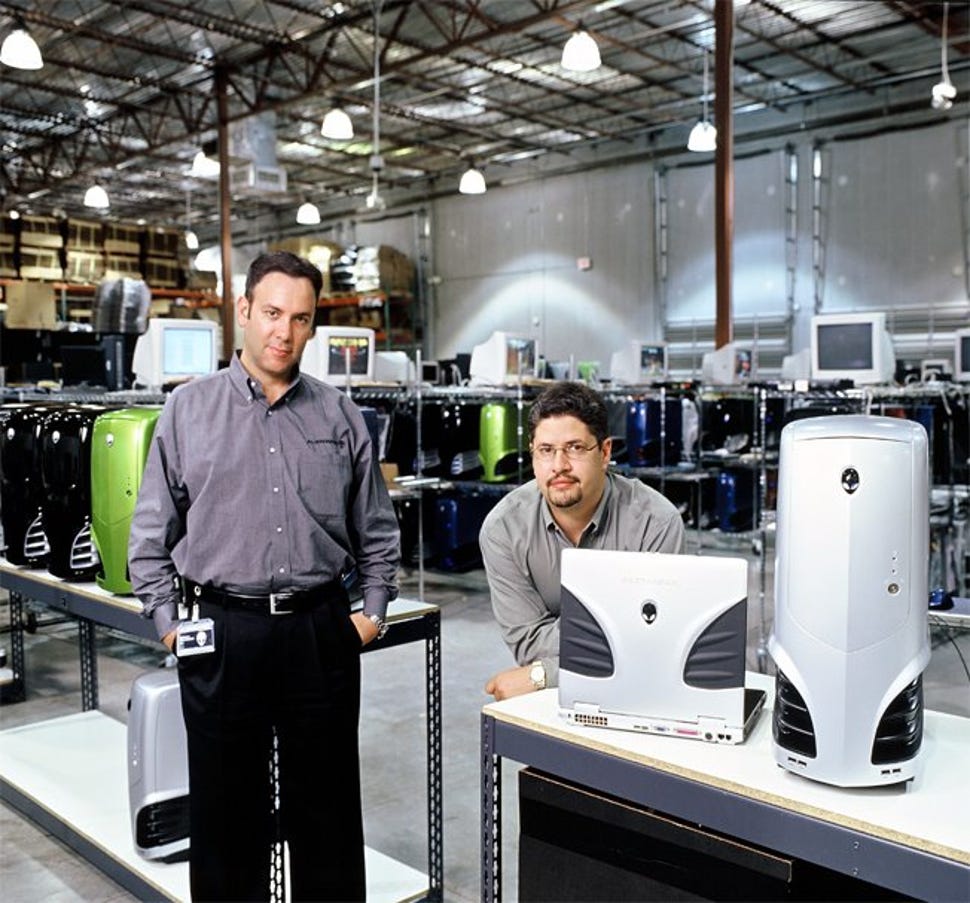
Alienware co-founders Nelson Gonzalez and Alex Aguila. / Alienware

For the company name, they mixed the words “alien” and “hardware.” Gonzalez wanted something that started with the letter A so it would be at the front of the Yellow Pages. “It almost became AAAlienware,” joked Arthur Lewis, another childhood friend of Gonzalez and Aguila who later served as Alienware’s president and CEO.

In 1997, the company created its first custom-built desktop computer, the Blade.

On a whim, Gonzalez began sending the machine to reviewers at popular magazines like PC Gamer. The response was better than he could hope for. He followed with the Area-51, named after the secret military base thought to be filled with alien technology collected by the US government. Boot magazine praised its speed and design, such as the extra fans that allowed owners to eke out even more performance. “The Area-51 computer is a remarkable device,” the magazine wrote.

Oculus VR goggles could change the future. Or not.

Standard

By Ian Sherr

The future of tech is here, and it may not be as much fun as you think.

To join in, you’ll need to strap a black, 1.5-pound mask to your face so you can have an out-of-body-like experience that might make you queasy. There’s also the chance you’ll trip on the 13-foot-long cord that connects the device to a PC.

Once you put the headset on, it really can make you feel like you’re in a different place. You may be sitting in a chair at home, but through the headset — which is basically holding a computer screen inches from your eyes — you’ll think you’re standing beneath a Tyrannosaurus rex, climbing Mt. Everest or exploring the ruins of the nuclear disaster zone in Chernobyl.

That’s the virtual-reality vision that Facebook’s Mark Zuckerberg will be delivering Monday, when the Oculus Rift headset officially launches. It’s also Zuckerberg’s big bet. He spent $2 billion in 2014 just to buy Oculus while its VR tech was still a prototype.

When the Rift goes on sale for $599 US (£499 or AU$649), most experiences will be video games, like the space shooter Eve: Valkyrie, the card game Dragon Front, and Job Simulator: The 2050 Archives, where robots have replaced all human workers.
But Zuckerberg, 31, has much grander visions. He sees a future where education, communication and entertainment take place inside virtual worlds that we all see through these headsets.

In that future, we won’t just take a video or photo. We’ll capture a moment using 360-degree cameras that record the people, things and action around us. Zuckerberg believes VR will allow us to relive precious moments — like, in his case, the first steps taken by his 4-month old daughter, Max — in a way we never could before.

“We’d be able to share that with our family and other close friends, and actually have them be there and feel it and see what it’s like,” Zuckerberg said at a conference last year.

To understand, try

Sam Dolnick got his first taste of VR about a year ago when he downloaded Vrse, an app that plays 360-degree videos on an iPhone. You can also explore those videos by opening the app, plopping the phone into a headset and then peering through the eye holes. Turn your head, and the video pans around.

“It blew me away,” Dolnick said. “There’s something powerful about this place where you just look around.”

He showed his phone and Google Cardboard VR viewer to his colleagues in the newsroom at The New York Times, where he’s an associate editor.

By spring 2015, the paper was working on what would become a specialized VR app and NYT-branded version of Cardboard, which it sent out free to a million subscribers in November. That first weekend, , including its flagship reader for viewing content on phones and tablets.

“There were many people in the building who thought it was a stunt, a neat trick to do and then move on with our lives,” Dolnick said.

Now they think differently.